Enter a keyword below to search for articles and products.
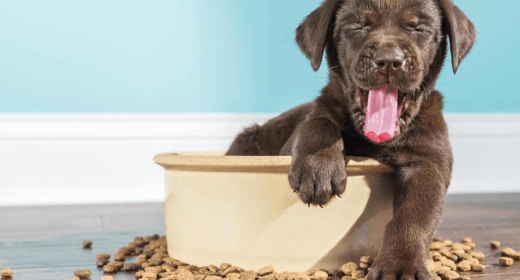
If you’ve got a big love for big dogs, IAMS™ has a large-breed puppy formula specially made for their nutritional needs.
Many large-breed puppies have a tendency to grow very quickly. Unfortunately, if this tendency is encouraged by overfeeding, developmental bone problems can occur. To avoid these problems, careful feeding management is necessary. This should include
Our specially formulated large-breed puppy formulas make feeding management easier because they are designed for fast-growing, large-breed puppies (those with an expected adult weight of more than 50 pounds).
A protein level approximating 26% in these formulas promotes healthy body condition and balances the protein with the reduced number of calories in the food. Research has shown that
The protein in our large-breed puppy formulas supports normal skeletal and muscular growth.
Fat contributes more than twice as many calories in a diet as proteins or carbohydrates do. As the fat level increases, the energy content of the diet also increases, making feeding management more difficult for large-breed puppies. Several studies have shown increases in developmental bone problems when a diet was overfed.2, 3
By reducing the fat content of large-breed puppy formulas to about 14%, the metabolizable energy (ME) of the diets can be kept to a low level of about 1,800 kilocalories per pound.
Fat contributes more than twice as many calories in a diet as proteins or carbohydrates
Our large-breed puppy formulas, such as IAMS ProActive Health™ Smart Puppy Large Breed, are made specifically for growing puppies with expected adult weights of 50 pounds or more. These puppy foods are unique because they are formulated with:
Reduced calcium and phosphorus levels with a normal calcium-to-phosphorus ratio to promote proper bone development in rapidly growing large breed puppies.
1 Nap, et al. Growth and skeletal development in Great Dane pups fed different levels of protein intake. J Nutr 1991; 121:S107-S113.
2 Hedhammer, et al. Over nutrition and skeletal disease: an experimental study in growing Great Dane dogs. Cornell Vet 1974; 64:1-159.
3 Lavelle. The effect of overfeeding of a balanced complete commercial diet to a group of growing Great Danes. In: Nutrition of the dog and cat. Burger and Rivers (eds). Cambridge Univ Press, 1989:303-316.
4 Hazewinkel, et al. Influences of chronic calcium excess on the skeletal development of growing Great Danes, J Am Anim Hosp Assoc 1985; 21:377-391.
5 Goedegebuure, Hazewinkel. Morphological findings in young dogs chronically fed a diet containing excess calcium. Vet Pathol 1986; 23:594-605.
6 Hazewinkel, et al. Calcium metabolism in Great Dane dogs fed diets with various calcium and phosphorus levels. J Nutr 1991; 121:S99-S106.
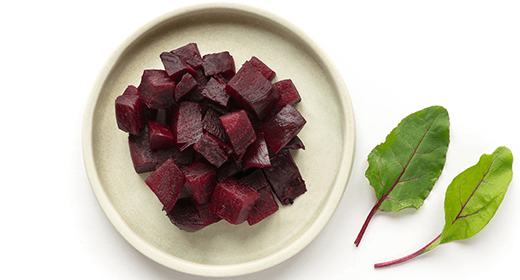
Beet pulp is the material that remains after sugar is extracted from sugar beets—not red beets. Beet pulp is a source of fiber in dog diets.
Fiber can be classified as nonfermentable and fermentable. Nonfermentable fiber remains undigested as it passes through the intestines, thereby providing bulk to move wastes out. Cellulose is a nonfermentable fiber.
Fermentable fiber is broken down in the intestines into short-chain fatty acids that provide energy for cells lining the intestine.
Moderately fermentable fiber does both: It provides bulk to move waste and provides energy for cells lining the intestine. Beet pulp is a moderately fermentable fiber.
'Beet pulp is harmful.'
Beet pulp contains no toxins and is a very safe fiber source.
'Beet pulp affects coat color.'
There is nothing in beet pulp that can affect coat pigment. The inside is light in color. The outside peel, which is dark, is not used.
'Beet pulp contains sugar.'
By definition, beet pulp is the material that remains after the sugar is removed from sugar beets. Therefore, beet pulp contains no sugar.
'Beet pulp causes bloat.'
Bloat (gastric dilatation-volvulus or GDV) is related to a stomach defect that delays emptying. It is believed that bloat is not related to diet or ingredients, such as beet pulp. However, the cause of bloat remains unknown.