Enter a keyword below to search for articles and products.


DHA (docosahexaenoic acid) is an omega-3 fatty acid important for neural development of puppies. DHA is a major structural component of the brain, as well as the most abundant fatty acid in the brain. It plays a vital role in the development of a puppy’s central nervous system and retinal function.
To help your puppy be as smart and healthy as possible, DHA should be an essential component of your dog's diet. The DHA in IAMS™ ProActive Health™ Smart Puppy food helps encourage healthy brain development, which can make your puppy more trainable and help forge a stronger bond with you.
Common dietary DHA sources include fish (such as salmon, sardines, tuna and other seafood), eggs and organ meat. In pet foods, sources of DHA include fish, fish meal and fish oil.
Prior to weaning, puppies get DHA from their mothers. The puppy’s mother transfers DHA from her body tissues to her offspring during pregnancy and lactation.
After weaning, puppies can obtain DHA through their diet.
One IAMS study looked at beagle puppies whose mothers had been fed enhanced or typical dietary DHA from breeding on through weaning.* After weaning, puppies were fed the same diets as their mothers throughout the remainder of the study (up to 16 weeks of age). To evaluate the effect of diet on trainability, all puppies were taught to associate a symbol with a direction in a t-maze, with correct responses resulting in a food treat.
In the 30 days of testing, puppies from the enhanced-DHA group consistently outperformed the puppies from the typical-DHA group on the maze test. Results of the study indicated that puppies nourished on high DHA levels were more trainable.
*Data on file. The IAMS Company.


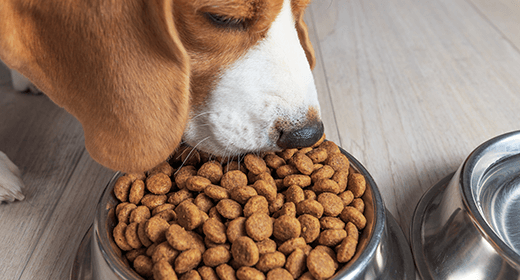
Your puppy’s nutritional needs will change as he grows into adulthood, but how do you know when your puppy is ready for adult food?
Depending on his breed size, at some point between 12 and 24 months of age, you should reexamine your puppy's nutritional needs and choose the right adult formula. His adult food could depend upon his metabolism (Does he gain weight easily?) and his activity level (Is it low, normal, or high?) These factors can help you find the ideal food for your dog.
The transition to a premium adult formula should begin when your dog approaches adult height and weight. The kind of dog you have will determine the right time to switch. When you do switch to adult formula, follow the same four-day process as you did when introducing your puppy to premium puppy food.
Small-breed dogs tend to mature physically much sooner than large-breed dogs. Follow these guidelines to help you decide when to switch formulas:
As your new puppy quickly matures into adulthood, he needs nutrition appropriate for his 'new' body. That means a high-quality, premium adult formula. Most veterinarians agree that feeding a complete and balanced premium food, such as IAMS™ ProActive Health™ Adult MiniChunks, throughout your dog's adulthood can promote a long and healthy life.