Enter a keyword below to search for articles and products.


DHA (docosahexaenoic acid) is an omega-3 fatty acid important for neural development of puppies. DHA is a major structural component of the brain, as well as the most abundant fatty acid in the brain. It plays a vital role in the development of a puppy’s central nervous system and retinal function.
To help your puppy be as smart and healthy as possible, DHA should be an essential component of your dog's diet. The DHA in IAMS™ ProActive Health™ Smart Puppy food helps encourage healthy brain development, which can make your puppy more trainable and help forge a stronger bond with you.
Common dietary DHA sources include fish (such as salmon, sardines, tuna and other seafood), eggs and organ meat. In pet foods, sources of DHA include fish, fish meal and fish oil.
Prior to weaning, puppies get DHA from their mothers. The puppy’s mother transfers DHA from her body tissues to her offspring during pregnancy and lactation.
After weaning, puppies can obtain DHA through their diet.
One IAMS study looked at beagle puppies whose mothers had been fed enhanced or typical dietary DHA from breeding on through weaning.* After weaning, puppies were fed the same diets as their mothers throughout the remainder of the study (up to 16 weeks of age). To evaluate the effect of diet on trainability, all puppies were taught to associate a symbol with a direction in a t-maze, with correct responses resulting in a food treat.
In the 30 days of testing, puppies from the enhanced-DHA group consistently outperformed the puppies from the typical-DHA group on the maze test. Results of the study indicated that puppies nourished on high DHA levels were more trainable.
*Data on file. The IAMS Company.


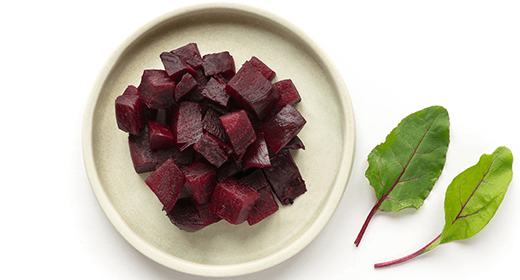
Beet pulp is the material that remains after sugar is extracted from sugar beets—not red beets. Beet pulp is a source of fiber in dog diets.
Fiber can be classified as nonfermentable and fermentable. Nonfermentable fiber remains undigested as it passes through the intestines, thereby providing bulk to move wastes out. Cellulose is a nonfermentable fiber.
Fermentable fiber is broken down in the intestines into short-chain fatty acids that provide energy for cells lining the intestine.
Moderately fermentable fiber does both: It provides bulk to move waste and provides energy for cells lining the intestine. Beet pulp is a moderately fermentable fiber.
'Beet pulp is harmful.'
Beet pulp contains no toxins and is a very safe fiber source.
'Beet pulp affects coat color.'
There is nothing in beet pulp that can affect coat pigment. The inside is light in color. The outside peel, which is dark, is not used.
'Beet pulp contains sugar.'
By definition, beet pulp is the material that remains after the sugar is removed from sugar beets. Therefore, beet pulp contains no sugar.
'Beet pulp causes bloat.'
Bloat (gastric dilatation-volvulus or GDV) is related to a stomach defect that delays emptying. It is believed that bloat is not related to diet or ingredients, such as beet pulp. However, the cause of bloat remains unknown.