Enter a keyword below to search for articles and products.
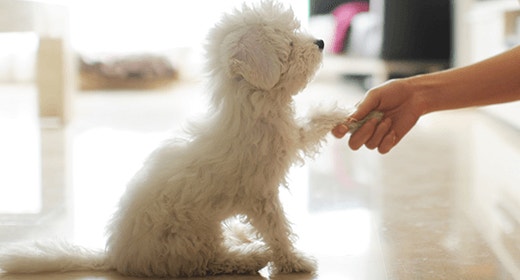
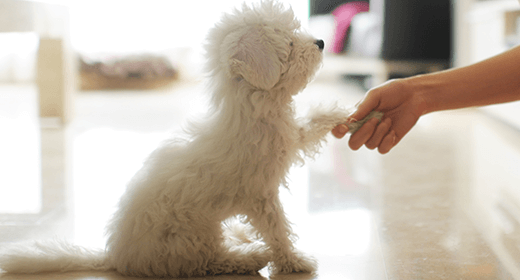
A new puppy is wonderful in pretty much every way, at least until they start having accidents around your apartment or house. But do not fear, Expert Pet Trainer Kathy Santo has all the answers. Watch as she takes you through the basics on everything from establishing a routine to rewarding your puppy when they eliminate outdoors.
House training your puppy requires more than a stack of old newspapers. It calls for patience, commitment, and above all, consistency. Hi, I'm Kathy Santo with IAMS, and today we're going to talk about how to house train your puppy. A trusting and consistent relationship is fundamental to successful house trading. The more consistent you are, the faster your puppy will learn. House training a puppy can take several weeks, and sometimes longer with smaller breeds. The first step to house training your puppy is to establish a routine. Puppies do best on a regular schedule, because it teaches them that there are times to eat, times to play, and times to potty. As a general rule, a puppy can control his bladder about an hour for every month of age. So if your puppy is only three months old, he can probably only hold it for about three hours, if not less. Make sure to take him right out after he wakes up, during and after play time, and after eating or drinking, because these are times he'd most likely to have to go. If you work, and are unable to take your puppy outside as often as needed, you could hire a dog walker to give your puppy his necessary breaks. I recommend picking a specific bathroom spot outside, and always taking him there first when he's on a leash. While your puppy is going, say something like, 'go potty,' so that you can eventually use that phrase to remind him what to do. You should take him out for a walk or play time after he's gone potty, or he might just learn to hold it to keep you outside. Reward your puppy every time he goes potty outdoors with praise or a treat, but make sure to do so immediately, before he goes back into the house. Rewarding correct behavior is the best way to teach your puppy. Be careful not to reward your puppy until he's completely finished, or he may forget to finish up outside, and then have an accident inside. And remember, what goes into a puppy on a schedule comes out of a puppy on a schedule. So always take your puppy out after feeding. Try picking up your puppy's water dish about two and a half hours before bedtime, so he won't have as much water to try and hold overnight. If you keep a consistent schedule, your puppy could be house trained by the time he's five to six months old. But don't be discouraged if it takes your puppy longer, or has an occasional accident. Many factors, including breed of dog, consistency, and temperament can contribute to a longer training period. If you feel that there's little to no progress, consult with your veterinarian to be sure that a medical issue, such as a bladder infection, isn't the culprit. Supervision in the beginning is critical. Exercise pens are extremely helpful while house training. Keeping your puppy in a small space within eyesight will allow you to notice and react when they start showing the signs of needing to eliminate. Those signs can be barking, scratching at the door, squatting, sniffing, or circling. If you're unable to monitor your puppy, you can confine him to an area small enough so that he won't want to eliminate there. A space just large enough for him to lay down with a couple extra inches is just fine. Many people choose to combine with a crate, which can be very helpful for house training your young dog. For more information on crate training, watch 'How To Crate Train Your Puppy.' I'm Kathy Santo with IAMS, and I hope that you found this helpful as you welcome your new addition to your family.
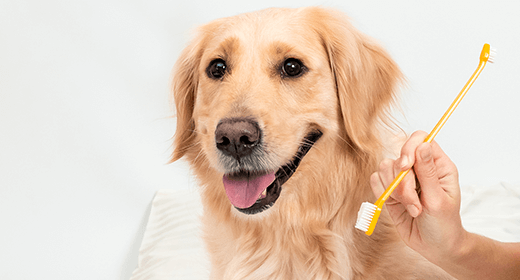
Dogs need regular dental care just like you do; gum disease and broken teeth are the major concerns. Fortunately, pets seldom suffer from tooth decay. Their cone-shaped teeth, non-acidic saliva, and low-sugar diets all help protect them from this nasty ailment. (Note: If you give your pets sweets for snacks, they can get cavities.)
Regular brushing and professional cleaning can keep your dog’s teeth healthy and gleaming. Giving your pet appropriate toys to chew prevents fractures.
Periodontal disease affects the gums, bones, and connective tissue around the teeth, and it can cause tooth loss. First, plaque—a soft, clear, or cream-colored deposit—forms on the teeth. If it isn't removed, minerals in the dog's saliva turn plaque into tartar. Tartar builds up below the gums, and bacteria grows, causing inflammation.
The same bacteria that causes the inflammation can enter your pet's bloodstream and cause or aggravate lung, kidney, liver, and heart problems. That's a lot of trouble, worry, and cost from something that could be stopped in its early stages.
When your puppy first begins to get permanent teeth, check carefully to be sure the baby teeth come out as the new teeth come in. Retained teeth can cause the permanent teeth to be crooked. Toy dog breeds, with their tiny jaws, are at special risk for this problem.
While hard foods and chew toys can help keep teeth clean, you need to get your pet used to regular tooth-brushing. As soon as you bring your new pet home, get him accustomed to having his mouth handled. This is good practice for dogs that will be shown; judges check to make sure dogs have their full set of teeth. It is also good training—it teaches the dog to tolerate having things in his mouth without biting or snapping.
What your dog eats affects his 'smile.' Dry foods and treats help clean plaque from his teeth. Rawhide chews are also good cleaning tools, as are some of the knobby plastic toys on the market. None of these are hard enough to cause tooth damage, but be sure to watch your pet to make sure small pieces of the toys aren't torn off and swallowed. Real bones can also be dangerous for your pet and should not be used for tooth-cleaning purposes.
All dry adult IAMS™ Dog Foods, such as IAMS ProActive Health™ Adult MiniChunks, include Daily Dental Care, a special kibble coating that helps reduce tartar buildup for better oral health.
It just takes a little time and patience. Begin by running your finger gently over his gums. At first, just rub the outside, but as he adjusts to the routine, begin to open his mouth and rub the gums inside the teeth as well.
As your dog gets accustomed to this, wrap your finger with gauze and rub his gums. Eventually, add a pet toothpaste; do not use human toothpaste. After a few weeks, your dog should be willing to accept a toothbrush for pets, which should have soft, multi-tufted synthetic bristles.
Hold the toothbrush at a 45-degree angle and apply it to the area where teeth and gums meet. Rotate it in small circles, overlapping several teeth. Finish with vertical strokes to pull plaque from between the teeth. Repeat until all the teeth on the cheek side are clean. The inside teeth will be more difficult, as your dog may resist opening his mouth, but eventually you'll be able to brush the inside and outside surfaces of all the teeth. For effective cleaning, brush your dog's teeth a couple of times a week.
If your dog won't cooperate with home brushing or if you already see brown tartar stains on his teeth or red and bleeding gums, it's time to turn to your veterinarian for help. He or she will give your dog general anesthesia and clean the teeth above and below the gum line to remove plaque and tartar. After the teeth are cleaned, they will be polished to remove microscopic plaque and to make the teeth smooth to discourage plaque from clinging.
Remember, dental care is as important to your pet's health as it is to your own—you owe it to your dog to provide regular tooth care and cleaning.