Enter a keyword below to search for articles and products.
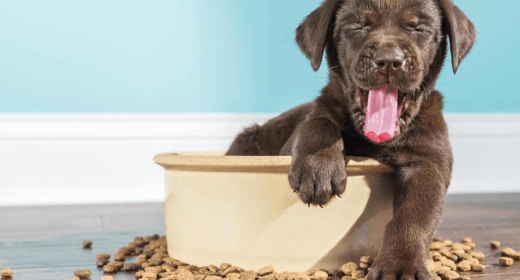
If you’ve got a big love for big dogs, IAMS™ has a large-breed puppy formula specially made for their nutritional needs.
Many large-breed puppies have a tendency to grow very quickly. Unfortunately, if this tendency is encouraged by overfeeding, developmental bone problems can occur. To avoid these problems, careful feeding management is necessary. This should include
Our specially formulated large-breed puppy formulas make feeding management easier because they are designed for fast-growing, large-breed puppies (those with an expected adult weight of more than 50 pounds).
A protein level approximating 26% in these formulas promotes healthy body condition and balances the protein with the reduced number of calories in the food. Research has shown that
The protein in our large-breed puppy formulas supports normal skeletal and muscular growth.
Fat contributes more than twice as many calories in a diet as proteins or carbohydrates do. As the fat level increases, the energy content of the diet also increases, making feeding management more difficult for large-breed puppies. Several studies have shown increases in developmental bone problems when a diet was overfed.2, 3
By reducing the fat content of large-breed puppy formulas to about 14%, the metabolizable energy (ME) of the diets can be kept to a low level of about 1,800 kilocalories per pound.
Fat contributes more than twice as many calories in a diet as proteins or carbohydrates
Our large-breed puppy formulas, such as IAMS ProActive Health™ Smart Puppy Large Breed, are made specifically for growing puppies with expected adult weights of 50 pounds or more. These puppy foods are unique because they are formulated with:
Reduced calcium and phosphorus levels with a normal calcium-to-phosphorus ratio to promote proper bone development in rapidly growing large breed puppies.
1 Nap, et al. Growth and skeletal development in Great Dane pups fed different levels of protein intake. J Nutr 1991; 121:S107-S113.
2 Hedhammer, et al. Over nutrition and skeletal disease: an experimental study in growing Great Dane dogs. Cornell Vet 1974; 64:1-159.
3 Lavelle. The effect of overfeeding of a balanced complete commercial diet to a group of growing Great Danes. In: Nutrition of the dog and cat. Burger and Rivers (eds). Cambridge Univ Press, 1989:303-316.
4 Hazewinkel, et al. Influences of chronic calcium excess on the skeletal development of growing Great Danes, J Am Anim Hosp Assoc 1985; 21:377-391.
5 Goedegebuure, Hazewinkel. Morphological findings in young dogs chronically fed a diet containing excess calcium. Vet Pathol 1986; 23:594-605.
6 Hazewinkel, et al. Calcium metabolism in Great Dane dogs fed diets with various calcium and phosphorus levels. J Nutr 1991; 121:S99-S106.
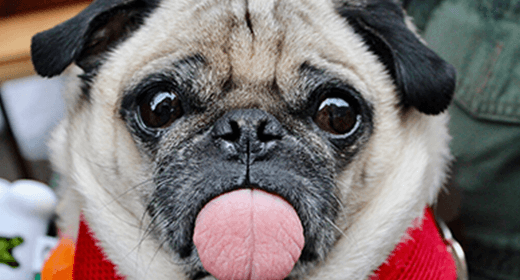
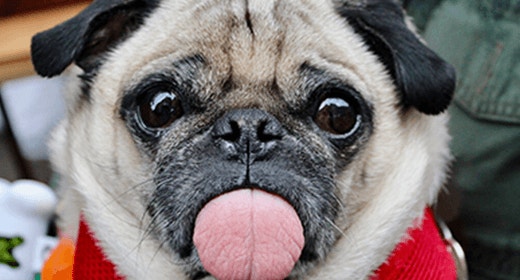
Worried that your small-breed dog is packing on the pounds? Run your hands along his backbone. You should be able to feel (but not see) his ribs. You also should see a clearly defined waist behind the ribs. If you can’t, follow these seven tips from Debra Eldredge, a veterinarian and co-author of “Dog Owner's Home Veterinary Handbook,” published by Howell Book House.
Before you put your overweight dog on a diet, schedule an appointment with the vet to make sure an underlying health problem isn’t causing the numbers on the scale to creep up.
Snacks and table scraps might account for your overweight dog’s bulging belly, Eldredge says. If curtailing in-between meals doesn’t make a difference, consider continuing with the same amount of food but switching to a different formula. Your vet can give you guidance.
Thawed frozen green beans, canned pumpkin (which is fiber-rich and filling) and cut-up carrots make satisfying, low-calorie snacks for your pet.
A study showed that dogs can count up to six or seven, Eldredge says. If he is accustomed to getting two small biscuits as a treat, break one biscuit into two pieces. By his count, he’s still getting two treats!
As much as your overweight dog loves treats, he also loves taking walks, playing and spending time with you. You also can replace biscuits with a couple of pieces of the kibble he would get during mealtime.
Is your bichon staring up at you with those beautiful eyes as you nibble on peanuts? He’s probably not hungry. As you have your snack, offer him a piece of kibble. If he turns it down, he’s not really hungry — he just wants your peanuts!
If your overweight dog has just a couple of pounds to lose, it can be hard to gauge whether he is making progress. Ask your clinic if it’s OK if you stop in once a week so he can step onto the doctor’s scale.