Enter a keyword below to search for articles and products.
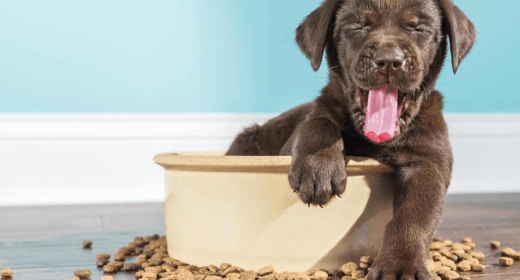
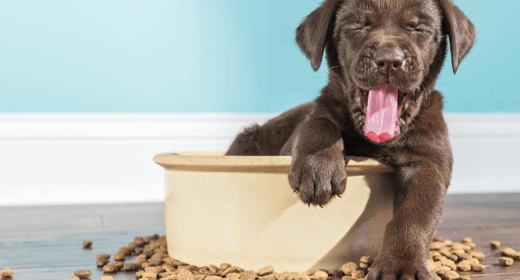
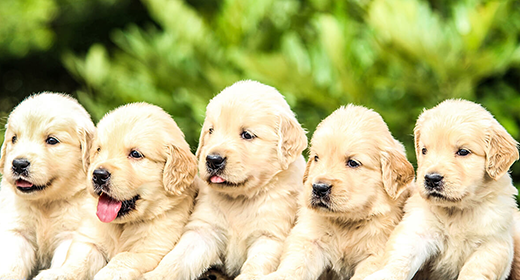
If you’ve got a big love for big dogs, IAMS™ has a large-breed puppy formula specially made for their nutritional needs.
Many large-breed puppies have a tendency to grow very quickly. Unfortunately, if this tendency is encouraged by overfeeding, developmental bone problems can occur. To avoid these problems, careful feeding management is necessary. This should include
Our specially formulated large-breed puppy formulas make feeding management easier because they are designed for fast-growing, large-breed puppies (those with an expected adult weight of more than 50 pounds).
A protein level approximating 26% in these formulas promotes healthy body condition and balances the protein with the reduced number of calories in the food. Research has shown that
The protein in our large-breed puppy formulas supports normal skeletal and muscular growth.
Fat contributes more than twice as many calories in a diet as proteins or carbohydrates do. As the fat level increases, the energy content of the diet also increases, making feeding management more difficult for large-breed puppies. Several studies have shown increases in developmental bone problems when a diet was overfed.2, 3
By reducing the fat content of large-breed puppy formulas to about 14%, the metabolizable energy (ME) of the diets can be kept to a low level of about 1,800 kilocalories per pound.
Fat contributes more than twice as many calories in a diet as proteins or carbohydrates
Our large-breed puppy formulas, such as IAMS ProActive Health™ Smart Puppy Large Breed, are made specifically for growing puppies with expected adult weights of 50 pounds or more. These puppy foods are unique because they are formulated with:
Reduced calcium and phosphorus levels with a normal calcium-to-phosphorus ratio to promote proper bone development in rapidly growing large breed puppies.
1 Nap, et al. Growth and skeletal development in Great Dane pups fed different levels of protein intake. J Nutr 1991; 121:S107-S113.
2 Hedhammer, et al. Over nutrition and skeletal disease: an experimental study in growing Great Dane dogs. Cornell Vet 1974; 64:1-159.
3 Lavelle. The effect of overfeeding of a balanced complete commercial diet to a group of growing Great Danes. In: Nutrition of the dog and cat. Burger and Rivers (eds). Cambridge Univ Press, 1989:303-316.
4 Hazewinkel, et al. Influences of chronic calcium excess on the skeletal development of growing Great Danes, J Am Anim Hosp Assoc 1985; 21:377-391.
5 Goedegebuure, Hazewinkel. Morphological findings in young dogs chronically fed a diet containing excess calcium. Vet Pathol 1986; 23:594-605.
6 Hazewinkel, et al. Calcium metabolism in Great Dane dogs fed diets with various calcium and phosphorus levels. J Nutr 1991; 121:S99-S106.
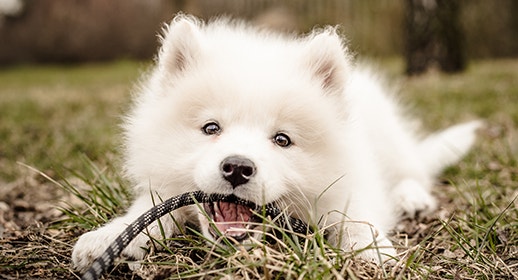
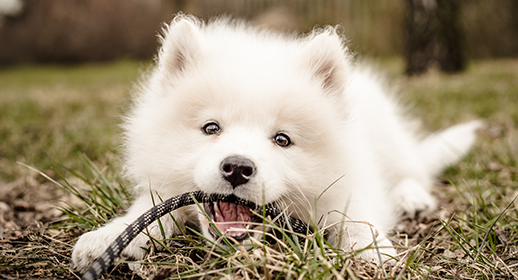
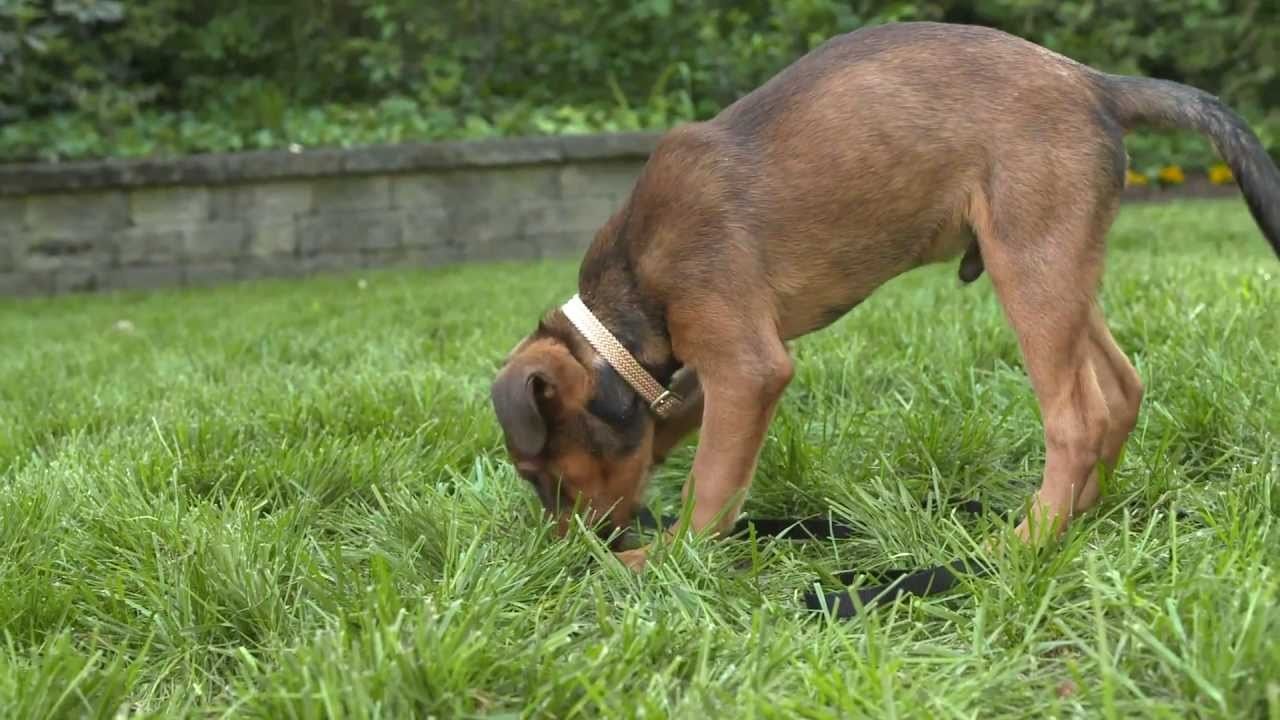
A puppy nibbling on your fingers may seem cute and harmless, but when he grows up, biting can become a hard habit to break. Join Expert Pet Trainer Kathy Santo as she explains the reasons puppies bite and what you can do to change their behavior.
Hi, I'm Kathy Santo with IAMS, and today we're going to discuss the dangers of allowing puppy biting, the importance of playing correctly, and how to stop the unwanted biting behavior.
It's normal and even cute when your puppy nibbles and lunges at your hands. Since your puppy has been exposed to only other puppies in the litter, who naturally play with biting and mouthing, it would make perfect sense why he would assume that playing with you wouldn't be different. But as puppies' teeth grow, and their bodies become stronger, what was once cute nibbling eventually turns into uncomfortable, or even dangerous, rough play and bites.
Since biting is an unacceptable type of play, it's important to teach your pup how to enjoy playing games with toys instead of your hand. Playing is a healthy, natural activity that helps build the bond between you and your puppy. This also affects your puppy's train ability-- sitting, waiting, learning tricks, not pulling on the leash, even to stop biting.
Before teaching your puppy not to bite, it's important to train your puppy to decrease bite pressure. Allow your puppy to begin mouthing and nibbling at your hand. When he bites down hard, yell 'ouch,' so he's startled and stops for a second. Continue allowing him to mouth your hand, making sure to speak up every time he bites too hard, so your puppy can learn your threshold for what is acceptable and what isn't.
Once your puppy understands your feedback about the strength of his bite, you can begin to reduce biting. The best way to teach your puppy not to bite is to redirect him to a toy or a chew bone. Simply give your dog a firm 'no,' and replace whatever he was biting with something he is allowed to chew.
If your puppy is three to six months old, there is a good chance he may be teething, so he might be trying to reduce discomfort by chewing. Try giving him an ice cube to chew on. It'll numb his gums and help alleviate the pain.
My favorite trick to get puppies to stop biting is to exaggerate, and pretend they've injured me, their friend. By pretending their nip actually hurt you, by pulling your hand away, yelling 'ouch,' and stop playing, you're replicating what other litter mates would do if another puppy were to cause them pain.
Managing and controlling puppy biting problems can be a major challenge for dog lovers. Puppy biting or nipping starts out as a bit of fun, but needs to be controlled quickly to avoid ongoing problems. Training your dog depends on a good relationship built on love and trust. It takes time to build a working partnership, and the more time and patience you have with your puppy from day one, the more obedient he'll be. Dogs want to please.
I'm Kathy Santo with IAMS, and I hope you found this as helpful as you welcome your new addition to your family.