Enter a keyword below to search for articles and products.


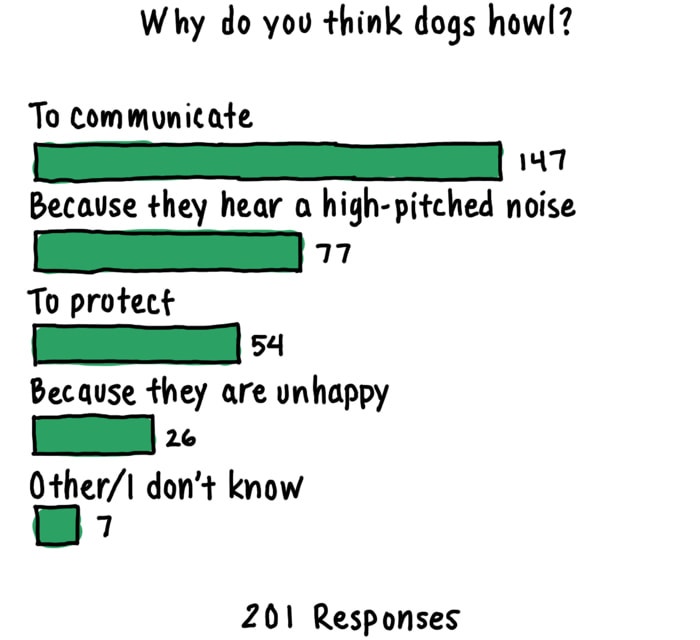
You’ve likely heard your dog let loose his inner wolf and belt out a few long howls. 73% of dog owners in a recent IAMS poll* believe they do this to communicate. This form of vocalization has a long history and is used for different reasons. Understanding more about howling will help you understand your pooch better.
Howling is an ancient trait wolves use to communicate with other members of their pack and other packs over long distances. They may be trying to locate a lost member, show off the size of their pack or warn of danger. It’s like a canine group text.
A wolf’s howl can be heard up to 10 miles away.
Each wolf has their own unique howl, so pack members know who they are, even miles apart.
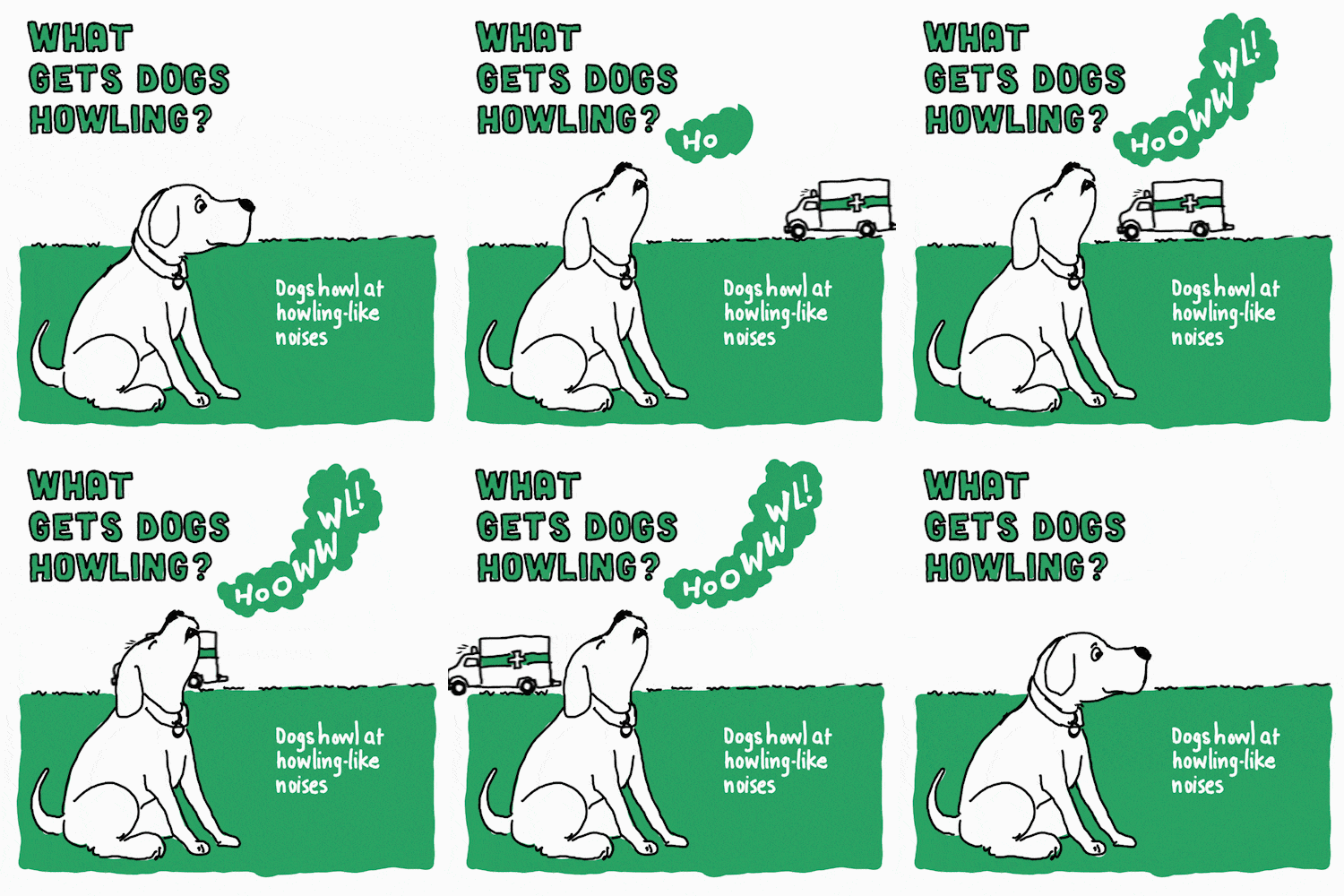
Dogs instinctually respond to howling-like noises by howling themselves. Sounds such as sirens, other dogs, singing or your kid learning the violin is usually enough to get them to sound off.
Dogs are still very social animals; it’s just that now we’re their pack. When they miss us, they’ll howl in hopes we respond.
Opens a new windowDr. James Serpell, BSc, PhD, Professor of Humane Ethics & Animal Welfare at University of Pennsylvania School of Veterinary Medicine, explains it this way: “That [howling] is an attempt on the part of the dog to ask the owner basically, ‘Where are you so that I can rejoin you?’”
Dr. James Serpell doesn’t believe so. “My own research has shown that it is common across breeds. People think huskies may be more prone to group howling.”
Dogs going through separation anxiety may howl excessively when left home alone. Dr. Jo Gale, BVetMed CertLAS MRCVS, Senior Manager for Global Science Advocacy at Waltham Petcare Science Institute, says, “If you reinforce quiet behavior, they are less likely to continue howling.” You can do this by quieting your dog and then leaving for a very brief time before returning and rewarding them when they stay quiet. Gradually increase the time you’re gone to reassure them you’ll always be back.
*Surveyed U.S. dog owners, age 18+
Sample Size: n=201
Fielded May 8 to May 10, 2020

Diet plays an important role in the endurance potential of canine athletes. The Alaskan sled dog might be considered the ultimate canine athlete, sometimes pulling a sled more than 1,000 miles in subzero temperatures. Providing a well-balanced diet is essential to meet the special needs of dogs in such nutritional-stress situations. Not only should the diet fed to these dogs be high in protein, but it also should be high in fat, which serves as the major energy source for exercising muscles.
A high-fat diet can help muscles burn fat more efficiently. During sustained exercise, fatty-acid oxidation is the primary source of energy for the muscles. Increasing the efficiency of fat metabolism spares the body’s use of carbohydrates, and because most dogs have in excess of 10 to 50 times more energy stored in fat than in muscle glycogen (carbohydrate), this might boost the animal's exercise performance.
IAMS™ studies1 have shown that in trained sled dogs as in ordinary dogs, exercise performance was enhanced by switching from a low-fat to a high-fat diet (from 25 to 65% of calories from fat), as indicated by increased:
When dogs were switched back to a low-fat diet, all of these criteria decreased to their previous values.
These results indicated that by increasing the availability of fat stores and capacity to metabolize fat for energy, a high-fat diet promotes exercise endurance in canine athletes.
1 Reynolds AJ, et al. “The effect of diet on sled dog performance, oxidative capacity, skeletal muscle microstructure, and muscle glycogen metabolism.” Recent Advances in Canine and Feline Nutritional Research: Proceedings of the 1996 IAMS International Nutrition Symposium. Carey DP, Norton SA, Bolser SM, eds. Wilmington, OH. 1996. 181–198.