Enter a keyword below to search for articles and products.
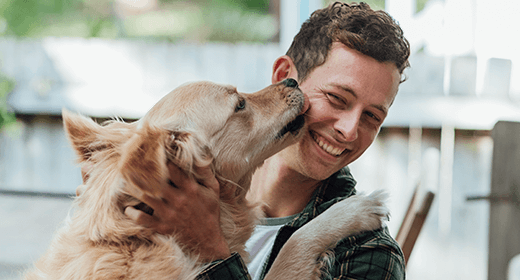
Adrena Wilhelm from Canine Companions for Independence shows you how you can teach your dog to speak and be quiet on command. She also provides effective techniques for teaching your dog to not bark when the doorbell rings and when other dogs are near.
Hi. I'm Adrena Wilhelm from Canine Companions for Independence on behalf of IAMS. Today, we're going to learn how to teach your dog to stop barking. It may sound nonsensical. But to stop your dog from barking, first, teach him to bark on command. Give your dog the command to speak. Have someone immediately make a noise, such as knocking on the door that is sure to make your dog bark. Let him bark two or three times. Then, stick a tasty treat in front of his nose. When he stops barking to sniff the treat, praise him and give him the treat. Repeat until he starts barking as soon as you say speak. Once your dog can reliably bark on command, move on to the quiet command. Teach your dog that barking is OK until told to be quiet. Simultaneously, hold a treat in front of your dog's nose. Most dogs get quiet immediately because they can't sniff and lick the treat while barking at the same time. Praise your dog continuously during his quiet time with petting and words of encouragement. When your dog makes a mistake and barks, and he will, reprimand him immediately. Never strike your dog, but do something that will catch his attention, such as clapping loudly. As soon as your dog stops barking, you must instantly reward him. If you're still having trouble, then you may need to spend some time working with your dog on specific barking situations. Here are a few of the more common ones. If your dog is in his crate or confined to a room behind a baby gate or other barrier, he may bark because he wants to be with you. But if that's not always possible, then you'll need to train him to stay quiet. Next time, he's barking uncontrollably in his more confined space, try this. Start by turning your back and ignoring him. Whenever he stops barking, turn and praise him. Give him a treat and make a game of it. As he catches on that being quiet gets him a treat, lengthen the amount of time that he must remain quiet before being rewarded. Dogs that are afraid of other dogs will often bark at them. Have a friend with a dog stand out of sight far enough away that you know your dog won't bark at the other dog. As soon as the friend and dog come into view, start feeding your dog lots of treats. Keep feeding treats until the friend and dog are out of sight. Ask your friend and her dog to gradually walk closer. Don't try to progress too quickly. It may take days or weeks before your dog can pay attention to you and the treats without barking at the other dog. When the doorbell rings, your dog alerts you to the presence of an intruder by barking wildly. Once you've taught your dog the quiet command in a calm environment, practice in increasingly distracting situations. Teach your dog to react to the doorbell by going to a special place and laying quietly while the intruder comes into the house. Start by tossing a treat on his mat and telling him go to your place. Have him go to his place before you give him the treat. When he's reliably going to his mat to earn a treat, up the ante by opening the door while he's on his mat. If he gets up, close the door immediately. Repeat until he stays on the mat while the door is open. Then, increase the difficulty by having someone ring the doorbell while your dog is on his mat. Reward him if he stays in his place. Try these techniques to stop your dog from barking. All of them can be successful, but don't expect miracles overnight. The longer your dog has been practicing the barking behavior, the longer it will take for him to change his ways. Let's recap. First, teach your dog to speak or bark on command. Once he has that down, teach him to be quiet on command. Use treats and praise to help get the desired outcome. And lastly, be patient and consistent in training. Don't expect overnight changes. I'm Adrena Wilhelm on behalf of IAMS. To join the IAMS community for more information and offers, check out the website.
Taking care of your new puppy can be overwhelming, but with these tips and lots of love, you’ll be a great puppy parent in no time.
Just like a baby, a puppy's body is fragile. Avoid picking up your puppy unless absolutely necessary. If you must, be careful and use these steps:
Step 1: Place one hand under your puppy's rump, and place your other hand under his chest.
Step 2: Lift with both arms. With a small adult dog, use the puppy technique. For larger dogs, wrap both arms around his legs, draw him to your chest, and lift.
Before you bring your puppy home, be sure you have the following supplies:
Keeping your puppy safe in your yard requires good fencing. There are several options to choose from, and the one you should pick will depend on your puppy's personality, your property, and your budget. Here are some of the options you should consider:
The ideal time to bring home a new puppy is when the house is quiet. Discourage friends from stopping by and don't allow overnight guests. First, establish a daily routine and follow these steps:
Step 1: Before bringing him in the house, take him to the designated potty area in your yard and spend a few minutes there. If he goes, praise him. Be sure to take him to this spot each time he potties.
Step 2: Take him to the room with his crate. This restricted area will serve as his new 'den' for several days. Put bedding and chew toys in the crate, leave the door open, and line the area outside of the crate with newspaper in case of an accident. Let him investigate the crate and the room. If he chews or urinates on his bedding, permanently remove it from the crate.
Step 3: Observe and interact with your puppy while he's getting used to his new den. This will help forge a sense of 'pack' and establish you as the pack leader.
Don't treat a puppy as young as 6 to 12 weeks like an adult dog. Treat him the same way you would an infant, with patience, constant supervision, and a gentle touch. The way you interact with your puppy at this age is critical to his socialization. Use these tips:
Ideally, your kids should help you choose your puppy. When you bring him home, don't let them play with him constantly. Puppies need a lot of rest, just like a growing child. Limit puppy-children play sessions to 15- to 30-minute periods, two to three times a day.
Meeting Resident Pets