Enter a keyword below to search for articles and products.


It depends on the breed of dog, but your pet's senior years generally begin at age 7. Louise Murray, DVM, director of the ASPCA's Bergh Memorial Animal Hospital in New York City and author of Vet Confidential (Ballantine, 2008), tells you what you need to know to keep your older dog spry and happy.
At this stage, Murray recommends taking your dog to the vet twice a year. 'So much can happen to an elderly dog,' she says. Your veterinarian can take blood annually to test liver and kidney functions. 'Discovering problems early is extremely important,' she says. Your vet can be on the lookout for conditions that often affect older dogs, such as anemia and arthritis.
Pay attention to what might be subtle changes in your dog's habits: Is she drinking more water or urinating larger amounts? These behaviors might indicate a liver or kidney problem. Have your dog's bowel movements shifted? This could indicate a digestive issue. Diabetes or digestive problems might cause your dog to eat more but still lose weight. Knowing the dog's patterns can help the veterinarian determine a course of treatment.
Continue to use preventive medicines.
Clean your dog's teeth daily. If she has tartar buildup, you might need to have her teeth professionally cleaned at your vet's office, which requires sedating your pet.
Your dog is probably less active, so steady, moderate exercise is best for her now. Don't turn her into a 'weekend warrior' who, after lying around on weekdays, accompanies you on a 10-mile hike on Saturdays. This is especially hard on an older dog's joints.
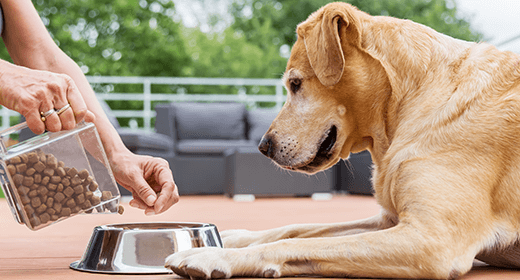
Your veterinarian might wish to put your dog on a senior diet, such as IAMS™ ProActive Health™ Senior Plus. These formulations contain nutrients specifically geared toward older-dog health.


Wheat is a grain used as a high-quality carbohydrate source in dry dog foods and biscuits. It provides energy for daily activity, as well as processing characteristics for the food. IAMS™ research has shown that including wheat in a complete and balanced diet results in a moderate glycemic response in dogs, which is lower, in general, than the response observed when a rice-based diet was fed. 1,2
A common misconception is that feeding wheat causes food allergies. The facts are:
Gluten (a protein found in wheat) is responsible for wheat-sensitive enteropathy, occasionally found in Irish Setters from the United Kingdom. Gluten enteropathy of Irish Setters is a malabsorption syndrome, which responds to the removal of wheat (gluten) from the diet. This condition is very rare, and the reason some dogs develop it is not yet clear.
1 Sunvold GD. “The role of novel nutrients in managing obesity.” In: Recent Advances in Canine and Feline Nutrition, Vol II: 1998 IAMS Nutrition Symposium Proceedings. Carey DP, Norton SA, Bolser SM, eds. Wilmington, OH: Orange Frazer Press, 1998; 123–133.
2 Bouchard GF. “Effect of dietary carbohydrate source on posprandial plasma glucose and insulin concentration in cats.” In: Recent Advances in Canine and Feline Nutrition, Vol III: 2000 IAMS Nutrition Symposium Proceedings. Reinhart GA, Carey DP eds. Wilmington, OH: Orange Frazer Press, 2000; 91–101.
3 Jeffers JG. “Responses of dogs with food allergies to a single-ingredient dietary provocation.” J Am Vet Med Assoc. 1996, vol 209(3): 608–611.