Enter a keyword below to search for articles and products.


Dogs are as unique as people, but despite their differences, they all need a well-balanced diet for good health. However, dogs of different ages and sizes have different nutritional needs, and this is especially true for puppies. When you factor in developmental needs, ingredients and your puppy’s size and breed, choosing the right food can be difficult.
The energy requirements of a puppy can be nearly twice those of an adult dog. This means that a puppy might not have the stomach capacity to eat enough food to meet his needs unless the food is specially formulated.
When choosing a puppy food, select one that provides a highly digestible, nutrient-dense, 100% complete premium formula for growth. Such high-quality formulas contain the vitamins, minerals, protein, fat and carbohydrates your dog needs for sound and healthy development. With a premium formula, your puppy may have:
Puppies grow fastest during the first six months of life, and because growth rates differ among breed sizes, you need a formula designed to address the needs of your puppy’s breed or size. Feed your puppy this formula based on the recommended amounts for his weight and age until he is an adult.
Although large-breed dogs have bigger bones than medium or small breeds, large-breed puppies do not need more calcium. University studies have shown that:
Overfeeding and weight gain can contribute to developmental bone problems. This makes managing food intake even more critical. Puppies are at greater risk for developmental bone problems if they are overfed.
A formula with reduced fat and calories promotes optimum growth. Controlling the rate of growth to promote normal development is another reason to feed a large-breed diet, such as IAMS™ ProActive Health™ Smart Puppy Large Breed.
Medium-breed puppies have needs between those of large- and small-breed dogs. A medium-breed puppy’s nutritional demands can be satisfied by feeding a 100% complete and balanced formula that features moderate amounts of all the essential vitamins and nutrients, such as IAMS ProActive Health Smart Puppy Original.

Small-breed puppies have unique needs due to their small mouths and small stomachs, as well as the rapid growth spurt they experience when growing to adult size. That’s why it’s important to pack a lot of nutrition and energy into a small amount of food. A poor-quality diet might fill a puppy’s stomach before he can eat enough food to satisfy his nutritional needs. The result can be improper muscle and skeletal development and growth impairment.
IAMS™ puppy foods are formulated to be energy- and nutrient-dense to meet the needs of growing puppies. The IAMS™ formula for small and toy puppy breeds, IAMS™ ProActive Health™ Smart Puppy Small & Toy Breed, has concentrated nutrition for the lifelong health of your small- or toy-breed dog.
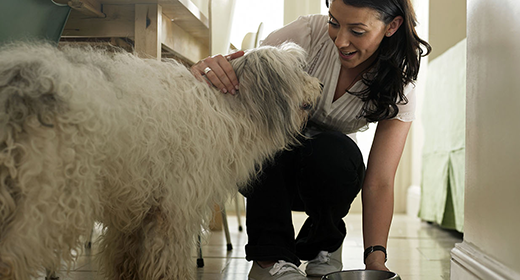
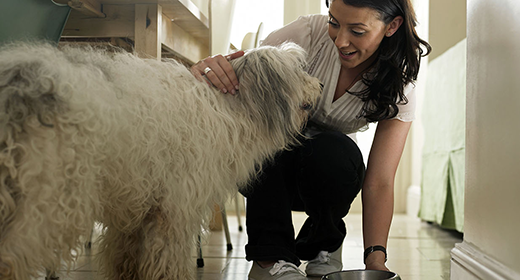
Dogs hit maturity around 7 years of age (5 years for larger dogs). It's not uncommon for them to live as long as 15 years. As your pet enters his golden years, his activity level might slow down and common conditions such as arthritis, diabetes, and kidney disease may arise. “It is so more important to monitor the eating habits of older pets,” stresses Tom Carpenter, DVM, president of the American Animal Hospital Association. “Generally, older pets do not need as much protein, sodium, and phosphorus. But your veterinarian needs to address this for your individual pet,” he says, adding that semiannual vet visits are recommended for an older animal.
Some mature dogs are prone to obesity. To test whether your dog is at a healthy weight, move your hands along his sides. If you can feel his ribs (but don't see them), he's doing okay. But if you feel a fat covering, or you visibly notice a rounded abdomen, he might be overweight. Exercise is still important for a senior dog, and if he's gained weight, you want to look for a low-fat weight-control food that contains vitamin-rich fish oils (IAMS™ ProActive Health™ Mature Adult is one good choice).
Other mature pets can become finicky eaters and lose weight as they age. 'Very old pets may actually need a more calorie-dense diet,' Carpenter says. Older dogs can lose their sense of smell and have a harder time chewing their food. To make mature dog food easier to eat, you can top their dry food with room-temperature wet food.
If your dog is gaining or losing a lot of weight, slightly decrease or increase his daily feedings. A sudden change in weight or appetite might be a sign of disease, so you should check with your vet. Water is also essential. 'Older pets are at a higher risk of dehydration,' Carpenter says. Provide a clean bowl with fresh water at all times.