Enter a keyword below to search for articles and products.


Diet plays an important role in the endurance potential of canine athletes. The Alaskan sled dog might be considered the ultimate canine athlete, sometimes pulling a sled more than 1,000 miles in subzero temperatures. Providing a well-balanced diet is essential to meet the special needs of dogs in such nutritional-stress situations. Not only should the diet fed to these dogs be high in protein, but it also should be high in fat, which serves as the major energy source for exercising muscles.
A high-fat diet can help muscles burn fat more efficiently. During sustained exercise, fatty-acid oxidation is the primary source of energy for the muscles. Increasing the efficiency of fat metabolism spares the body’s use of carbohydrates, and because most dogs have in excess of 10 to 50 times more energy stored in fat than in muscle glycogen (carbohydrate), this might boost the animal's exercise performance.
IAMS™ studies1 have shown that in trained sled dogs as in ordinary dogs, exercise performance was enhanced by switching from a low-fat to a high-fat diet (from 25 to 65% of calories from fat), as indicated by increased:
When dogs were switched back to a low-fat diet, all of these criteria decreased to their previous values.
These results indicated that by increasing the availability of fat stores and capacity to metabolize fat for energy, a high-fat diet promotes exercise endurance in canine athletes.
1 Reynolds AJ, et al. “The effect of diet on sled dog performance, oxidative capacity, skeletal muscle microstructure, and muscle glycogen metabolism.” Recent Advances in Canine and Feline Nutritional Research: Proceedings of the 1996 IAMS International Nutrition Symposium. Carey DP, Norton SA, Bolser SM, eds. Wilmington, OH. 1996. 181–198.
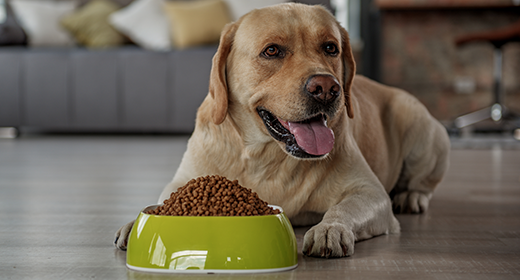
No two dogs are alike. So when choosing your pet's food, you'll want to take into consideration the dog's breed, size, age, weight, and lifestyle.
Full growth will happen at around 1 to 2 years, with the exact age determined by your dog's breed—small-breed dogs mature faster than large-breed dogs. “Grown dogs, especially ones who are more athletic, will start to eat more quantities in one feeding,” says Madan Khare, DVM. “You want to limit his feeding to one or two times a day, depending on his activity level.” Exact quantities should be determined by consulting your vet or by reading the package labels (just remember to split a daily serving in half if you choose to feed the dog twice a day).
When transitioning your dog from puppy food to premium adult food—such as IAMS™ ProActive Health™ Adult MiniChunks —you want to do it gradually. “Never change a dog's diet abruptly,” Khare says. Here's a schedule for transitioning your pet from puppy food to an adult dog food.
Day 1: Fill your dog's bowl with 75% puppy food and 25% premium adult dog food.
Day 2: Use 50% of each food.
Day 3: Feed your dog a mixture of 75% premium adult food and 25% of your current dog food.
Day 4: Give him 100% premium adult dog food.
Daily exercise and a diet packed with high-quality protein from chicken, lamb, or fish and essential nutrients will keep him happy and healthy throughout his lifetime. Premium dry pet food has all of the daily nutrition your pet needs. It helps promote healthy teeth and gums, too.
“When it comes to feeding your dog human food, I have three words,” Khare says. “No. No. No.” Interfering with your pet's food regimen by adding higher-fat and higher-calorie human foods can disturb the animal's digestive system. When it comes to biscuits, Khare recommends looking for ones low in sugar, salt, and fat. 'You have to keep in mind that you're adding calories to his daily diet, so offer them in moderation,” Khare says. Finally, make sure your pet has a clean bowl of fresh water at all times.