Enter a keyword below to search for articles and products.
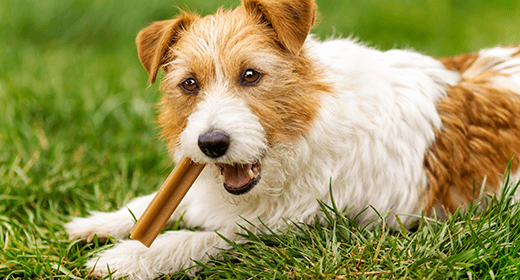
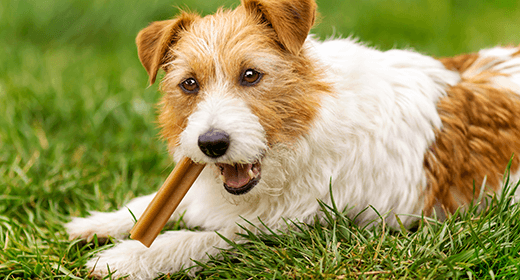
Dogs love to chew on things. In fact, chewing is a natural canine behavior. Providing appropriate chew treats and chew toys can be rewarding for the dog and might prevent or eliminate possible destructive chewing behavior. Chewable treats/toys are designed to provide that important natural chewing activity that dogs love. If the chew treat/toy has other benefits, such as oral care, that's even better.
Make enjoying chew treats and chew toys a safe and healthy activity with these tips:
Tip #1: There is some risk of digestive-tract obstruction with any type of chew treat or chew toy. Safety is always a concern when a dog chews. Many natural objects, such as sticks, rocks, and bones, can get stuck in a dog’s throat or intestine. As a dog owner, you are ultimately responsible to monitor your dog closely to make certain that the chew treat is chewed well.
Tip #2: Chew treats and chew toys should be sized appropriately for your dog. In other words, your dog should not be given a chew treat/toy that could be swallowed whole. Packages should indicate the appropriate size dog for the chew treat/toy. If in doubt, ask your retailer or contact the manufacturer.
Tip #3: Observe your dog playing with the chew toy or eating the chew treat. With the chew treat, your dog should gnaw on it with the side teeth and swallow pieces of the edible chew. Because dogs don't have the same crushing molars that humans have, they will “slice” off pieces with the side teeth. Many dogs will hold the treat in their paws or simply move it from side to side in their mouth as they chew off small pieces.
Tip #4: If your dog has a history of ingesting foreign objects such as rocks, sticks, or toys, you might not want to give him or her chew treats/toys at all. Try edible biscuits, instead.
Tip #5: Watch for choking, excessive drooling, vomiting, poor appetite, lethargy, and abnormal bowel movements. If you notice any of these signs, seek veterinary care sooner rather than later!
Tip #6: When in doubt about what is appropriate for your dog, contact your veterinarian. He or she can offer professional advice.
Diet plays an important role in the endurance potential of canine athletes. The Alaskan sled dog might be considered the ultimate canine athlete, sometimes pulling a sled more than 1,000 miles in subzero temperatures. Providing a well-balanced diet is essential to meet the special needs of dogs in such nutritional-stress situations. Not only should the diet fed to these dogs be high in protein, but it also should be high in fat, which serves as the major energy source for exercising muscles.
A high-fat diet can help muscles burn fat more efficiently. During sustained exercise, fatty-acid oxidation is the primary source of energy for the muscles. Increasing the efficiency of fat metabolism spares the body’s use of carbohydrates, and because most dogs have in excess of 10 to 50 times more energy stored in fat than in muscle glycogen (carbohydrate), this might boost the animal's exercise performance.
IAMS™ studies1 have shown that in trained sled dogs as in ordinary dogs, exercise performance was enhanced by switching from a low-fat to a high-fat diet (from 25 to 65% of calories from fat), as indicated by increased:
When dogs were switched back to a low-fat diet, all of these criteria decreased to their previous values.
These results indicated that by increasing the availability of fat stores and capacity to metabolize fat for energy, a high-fat diet promotes exercise endurance in canine athletes.
1 Reynolds AJ, et al. “The effect of diet on sled dog performance, oxidative capacity, skeletal muscle microstructure, and muscle glycogen metabolism.” Recent Advances in Canine and Feline Nutritional Research: Proceedings of the 1996 IAMS International Nutrition Symposium. Carey DP, Norton SA, Bolser SM, eds. Wilmington, OH. 1996. 181–198.