Enter a keyword below to search for articles and products.
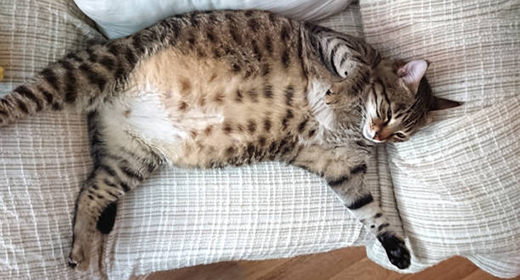
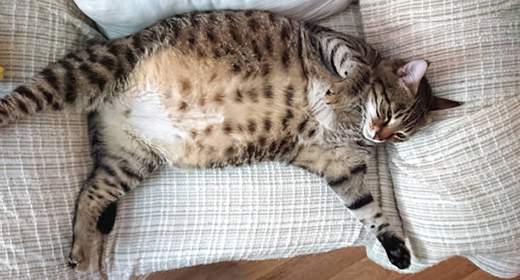
Pregnancy and nursing are responsible for many changes in a cat's lifestyle, as well as in her body. You should pay special attention to your cat’s changing nutritional needs throughout the entire reproduction process.
If you are planning to breed your female cat, it is important to assess her body condition well in advance. Because of the physical demands of pregnancy and nursing, starting off with less-than-ideal health can cause problems.
An underweight cat often can't consume enough food to support her and the developing kittens. Overweight cats may experience abnormal or difficult labor because of large fetuses.
A complete and balanced diet that supports a healthy weight and body condition before breeding helps the female cat maintain her health, and that of her offspring, throughout pregnancy and nursing.
The gestation period for cats is nine weeks. Pregnant cats, like humans, gain weight gradually throughout pregnancy. The energy requirements of pregnant cats are reflected by their weight gain. The energy needs of a pregnant cat should gradually increase so that, by the end of pregnancy, the cat is consuming 25% to 50% more than her normal amount of calories.
Pregnant cats lose weight after giving birth. However, their nutritional needs increase dramatically. Energy needs can be two to three times normal, depending on litter size, in order to produce the milk supply that will support the offspring. Water intake is also important for milk volume.
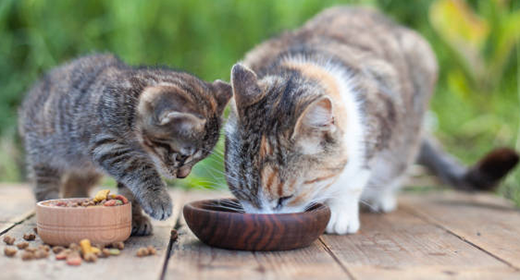
To ensure a nursing cat is getting enough nutrition, give her a nutrient-dense diet, such as kitten food. Without increasing the amount of food at each meal, increase the number of meals in the day. Free-choice feed her, offering unlimited access to dry food.
By 5 weeks, most kittens show an interest in their mother's food. Gradually, the kittens will begin eating solid food and nursing less. At the same time, the nursing cat will usually start eating less. Most kittens are completely weaned by eight weeks after birth. By this time, the mother's energy requirement is back to normal and she should be eating her usual pre-pregnancy diet.
Understanding and learning how to decipher kitten food product codes will help you choose the right kitten food. While selecting the right ingredients is important, making sure those ingredients are fresh is just as vital to your young cat. Learn how to read the product codes of kitten food packages and cans with our handy guide.
A product code is a series of numbers and letters printed on the outer package of each product a manufacturer produces. This code provides information about when and where the kitten food was made.
As part of the product code, IAMS™ products include a “Best Used By” date, or the date at which the product is no longer considered fresh and should no longer be sold. This date is expressed in “ddmmyy” and “ddmmmyy” formats.
The second line of the product code represents company internal information for use in traceability and inventory control.
Line 1: (ddmmyy) (ddmmmyy)
Example: 040220 04FEB20
Line 2: 60351111## QQQQQQQ
This product should be used before February 4, 2020.
Depending on the production line, pouch products* may have code date information in a single or double line. By recognizing and understanding these codes, customers can make sure they are receiving a fresh product.
Shelf life is the duration, measured in months, during which a properly stored kitten food product maintains its freshness. This means if a product has a 16-month shelf life, it is fresh for up to 16 months from the date of manufacture.
The shelf life for IAMS dry kitten foods is 16 months. All canned formulas have a shelf life of 24 months.
Unopened dry kitten food products are best stored off the floor in a cool, dry place. Open bags of kitten food should be stored in a clean, dry container with a tight seal. Dry kitten food products may also be frozen without loss of nutrients.
Opened wet kitten food products are best kept refrigerated in tightly sealed containers for no more than three days after the container has been opened. Wet products should not be frozen in unopened cans. However, wet kitten foods can be frozen if removed from the container, packed in freezer containers and frozen immediately.
*IAMS has no kitten pouch products at this time.