Enter a keyword below to search for articles and products.


Pregnancy and nursing are responsible for many changes in a cat's lifestyle, as well as in her body. You should pay special attention to your cat’s changing nutritional needs throughout the entire reproduction process.
If you are planning to breed your female cat, it is important to assess her body condition well in advance. Because of the physical demands of pregnancy and nursing, starting off with less-than-ideal health can cause problems.
An underweight cat often can't consume enough food to support her and the developing kittens. Overweight cats may experience abnormal or difficult labor because of large fetuses.
A complete and balanced diet that supports a healthy weight and body condition before breeding helps the female cat maintain her health, and that of her offspring, throughout pregnancy and nursing.
The gestation period for cats is nine weeks. Pregnant cats, like humans, gain weight gradually throughout pregnancy. The energy requirements of pregnant cats are reflected by their weight gain. The energy needs of a pregnant cat should gradually increase so that, by the end of pregnancy, the cat is consuming 25% to 50% more than her normal amount of calories.
Pregnant cats lose weight after giving birth. However, their nutritional needs increase dramatically. Energy needs can be two to three times normal, depending on litter size, in order to produce the milk supply that will support the offspring. Water intake is also important for milk volume.
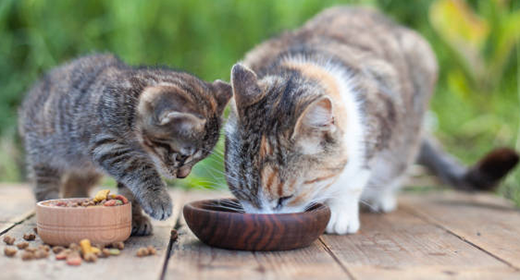
To ensure a nursing cat is getting enough nutrition, give her a nutrient-dense diet, such as kitten food. Without increasing the amount of food at each meal, increase the number of meals in the day. Free-choice feed her, offering unlimited access to dry food.
By 5 weeks, most kittens show an interest in their mother's food. Gradually, the kittens will begin eating solid food and nursing less. At the same time, the nursing cat will usually start eating less. Most kittens are completely weaned by eight weeks after birth. By this time, the mother's energy requirement is back to normal and she should be eating her usual pre-pregnancy diet.
Your cat is one of a kind, so it stands to reason that you want to choose a cat food that accounts for their unique tastes, age, breed and health concerns. But with thousands of pet foods available, how do you pick the one that’s right for your cat?
First, it’s important to understand your cat’s nutritional needs. Then, you’ll need to think about your cat’s life stage, lifestyle and any health issues, and do a bit of research on cat food types, ingredients and cost. That may sound complicated, but we’ll make it easy for you — just keep reading.
Good nutrition is as important to your cat as it is to you — but their nutritional needs are quite different! Unlike humans, a cat needs a high-fat diet with less fiber. And even if you prefer a vegetarian diet, keep in mind that cats are carnivores. They need nutrients from animal protein and fat for optimal health, and they benefit from fiber for a healthy digestive tract and carbohydrates for energy.
Kittens, adult cats, nursing mothers and mature or senior cats are all examples of life stages, and each has different nutritional requirements. All cat foods should state which life stage they are recommended for — as an example, IAMS™ Proactive Health™ Mother and Kitten as well as IAMS™ Proactive Health™ Healthy Adult include the intended life stage right on the package.
Nutritional needs also vary depending on your cat’s lifestyle. A cat whose primary activity is guarding the couch doesn’t need as much energy as one who enjoys roaming outside.
.
Because cats need the nutrients found in animal sources, it’s best to pick a food in which a primary ingredient (one of the first ones listed) is an animal-based protein source such as chicken, lamb, fish, egg or one of their by-products. These ingredients contain all the essential amino acids your cat needs, including taurine, which isn’t found in a plant-based protein source. Foods that include a combination of carbohydrates in your cat’s diet, such as corn meal or barley and grain sorghum, ensure efficient absorption of nutrients and help maintain energy levels. And beet pulp is an excellent fiber source that promotes a healthy digestive tract.
For a soft, thick coat and healthy skin, your pet needs fatty acids like those found in vitamin-rich fish oils and quality fat sources such as chicken.
Cat food labels provide limited information on the nutritional value of your pet’s food because labeling regulations do not allow manufacturers to describe the quality of ingredients on the package. A reputable pet food manufacturer can explain how they evaluate and ensure the quality of their products.
When choosing cat food, the saying “You get what you pay for” definitely applies. A low price may indicate cheap ingredients or ingredients that change as manufacturer costs fluctuate. So while price is an important factor, it shouldn’t be the only one you consider.
Plus, many lower-priced products recommend higher daily portions to provide the same amount of nutrition found in a high-quality diet. To get a better idea of cost, it is the cost per feeding, not the total cost, that counts.
To figure out the cost per feeding for a cat food, divide the total cost by the number of days the product lasts. When compared closely, high-quality pet foods tend to come out on top, from both a nutritional and a cost standpoint.