IAMS IN
cat-article-your-cat-overweight-underweight-or-just-right
cat-article-your-cat-overweight-underweight-or-just-right-mob

adp_description_block170
Is Your Cat Overweight, Underweight or Just Right?

  • Share

This article is part of a series on how to spot signs of a healthy cat. You can learn more about the key signs here.


Assessing your cat’s body condition is an important step in evaluating their overall nutritional well-being. Particularly in cases where your cat appears to be obese or thin, it is important to evaluate their total health before consulting a vet for a proper nutritional management program. Look for the following signs that your cat is overweight, underweight or just the right size.


thin cat i

underweight cat i

ideal weight cat i

overweight cat i

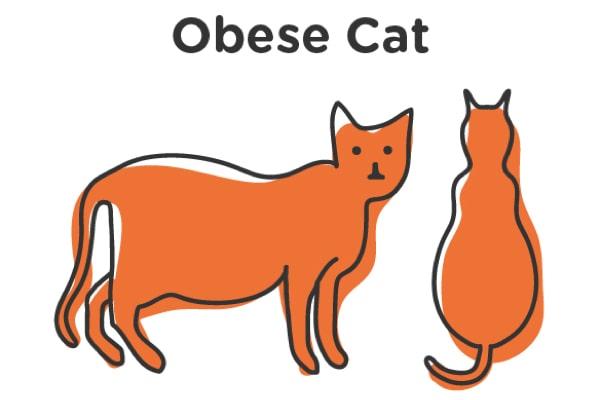
obese cat i


Thin Cat

  • Ribs, lumbar vertebrae and pelvic bones are easily visible
  • Thick neck and narrow waist
  • Obvious abdominal tuck
  • No fat in flank folds; folds are often absent

 Underweight Cat

  • Backbone and ribs can be easily seen or felt
  • Minimal fat covering
  • Minimal waist when viewed from above
  • Slightly tucked abdomen

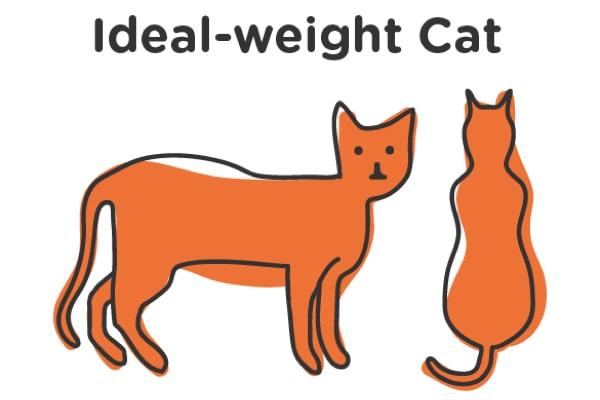
Ideal-weight Cat

  • Ribs are easily felt, but not visible
  • A slight waist can be seen behind the ribs when viewed from above
  • Abdomen is tucked up and flank folds are present

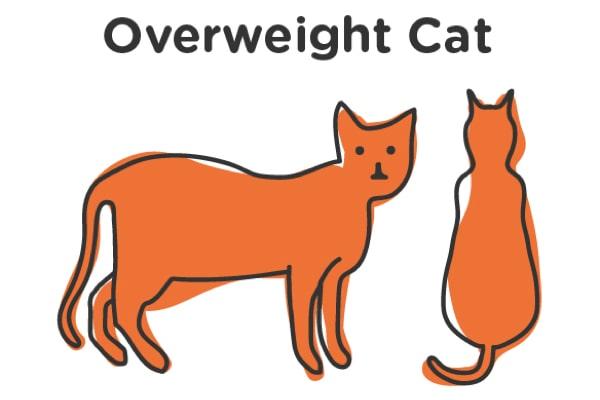
 Overweight Cat

  • Slight increase in fat over ribs, but still easily felt
  • Abdomen is slightly rounded and flanks are concave
  • Flank folds hang down with moderate amount of fat — you might notice a jiggle when your cat is walking

 Obese Cat

  • Ribs and backbone aren’t easily felt under a heavy fat covering
  • Abdomen is rounded; waist is barely visible or absent
  • Prominent flank folds sway from side to side when your cat is walking

  • Understanding Kitten Food Nutrition Labels
    Understanding Kitten Food Nutrition Labels
    adp_description_block380
    Understanding Kitten Food Nutrition Labels

    • Share

    Confused by the ingredient list on your kitten’s food? You’re not alone. Marketing pet foods that have “human-grade ingredients” is becoming commonplace. While appealing to many pet owners, it is important to be aware that the term “human grade” has no legal definition and is used primarily for marketing purposes.


    Foods, typically meats, are labeled either as “edible” or “inedible, not for human consumption.” Once a food leaves the human food chain, even if it is of outstanding quality, it has to be labeled “inedible, not for human consumption.” Therefore, meats used in pet food must be labeled as “inedible,” regardless of the source or quality of the meat. The only way to make a pet food with ingredients deemed “edible” is to never let the meat leave the human food chain and actually manufacture the pet food in a human food facility and transport it using human food trucks. Therefore, advertising a product as containing “human-grade ingredients” is untrue if it is not manufactured in a human food facility. However, just because a pet food isn’t marketed as being “human grade” does not mean that the ingredients are poor quality.


    Here are some tips to help understand ingredient labels:


    • The ingredient list is not the only method you should use to select a pet food, because it doesn’t provide pet owners with enough information about the quality of the ingredients or the nutritional adequacy of the overall diet.
    • Instead of concentrating on ingredients, pet owners and veterinarians should look at the AAFCO nutritional adequacy statement and the quality control protocols of the manufacturer. For more information, see the World Small Animal Veterinary Association’s brochure “Selecting the Best Food for your Pet,” available at www.wsava.org/nutrition-toolkit.
    • The ingredient list may be arranged to make foods as appealing as possible to consumers by the order of the ingredients (e.g., having lamb first on the ingredient list) or inclusion of seemingly desirable ingredients in the diet, but often in such small amounts that they have little or no nutritional benefits.
    • Having more ingredients does not make a diet more nutritious.

Close modal