Enter a keyword below to search for articles and products.


How can you help your kitten live a long and healthy life? Although you can’t predict the health of your cat with certainty, you can increase the probability of both her general health and a long life through proper care that begins as soon as you bring her home. Your veterinarian can advise further on these five key considerations for taking care of your kitten.
Feed your kitten high-quality food designed to meet nutritional needs during specific stages of her life. Your kitten’s nutritional requirements will depend on her life stage and lifestyle. No matter the life stage, cats are carnivores and require nutrients from animal protein and fat for optimal health.
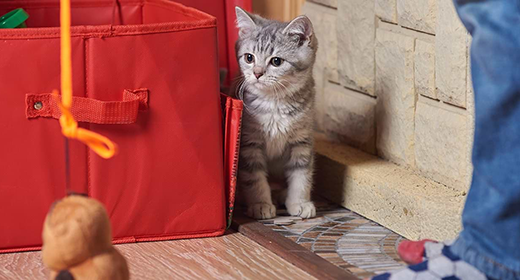
Prevent obesity with prudent portion control and frequent play activities. Exercise relieves stress, reduces aggression and keeps cats alert. Just 15 to 30 minutes of play a day can help keep your cat in shape and strengthen the bond between the two of you. In addition, getting your kitten used to playtime early on will help you get used to playing with your cat routinely.
Keep your kitten inside to help reduce the risk of illness or injury from accidents, fights and disease. As your kitten gets older, you can help avoid the stress of harassment from other animals by keeping your kitten inside. You should make your home safe by protecting your cat from environmental dangers, such as household cleaners and secondhand smoke. Cats frequently groom themselves with their tongues, and over time, even small amounts of harmful chemicals can have adverse effects.
Groom your kitten early and often to get her used to brushing. When brushing, check for bumps or abnormalities, and promptly seek veterinary advice if you discover anything suspicious. Take your cat to the veterinarian at least annually for a complete physical exam, and follow your veterinarian’s advice regarding preventive health care measures.
Your veterinarian may also recommend periodic professional cleaning of your cat’s teeth, which may preserve years of her life.
Last but not least, give your cat lots of love! Despite some cats’ aloof demeanor, all cats thrive on affection. Both you and your cat will reap the benefits of spending quality time together.
It was once thought that one year in the life of a cat was equivalent to seven years of a human life. Below is a revised way of looking at how a cat year stacks up to a human year.
| Cat Age | Human Age |
| 6 months | 10 years |
| 8 months | 13 years |
| 10 months | 14 years |
| 1 year | 15 years |
| 18 months | 20 years |
| 2 years | 24 years |
| 3 years | 28 years |
| 4 years | 32 years |
| 5 years | 36 years |
| 6 years | 40 years |
| 7 years | 44 years |
| 8 years | 48 years |
| 9 years | 52 years |
| 10 years | 56 years |
| 11 years | 60 years |
| 12 years | 64 years |
| 13 years | 68 years |
| 14 years | 72 years |
| 15 years | 76 years |
| 16 years | 80 years |
| 17 years | 84 years |
| 18 years | 88 years |
| 19 years | 92 years |
| 20 years | 96 years |
| 21 years | 100 years |
Pregnancy and nursing are responsible for many changes in a cat's lifestyle, as well as in her body. You should pay special attention to your cat’s changing nutritional needs throughout the entire reproduction process.
If you are planning to breed your female cat, it is important to assess her body condition well in advance. Because of the physical demands of pregnancy and nursing, starting off with less-than-ideal health can cause problems.
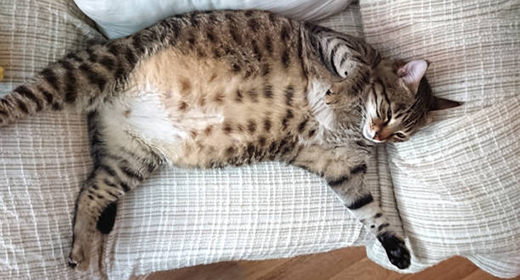
An underweight cat often can't consume enough food to support her and the developing kittens. Overweight cats may experience abnormal or difficult labor because of large fetuses.
A complete and balanced diet that supports a healthy weight and body condition before breeding helps the female cat maintain her health, and that of her offspring, throughout pregnancy and nursing.
The gestation period for cats is nine weeks. Pregnant cats, like humans, gain weight gradually throughout pregnancy. The energy requirements of pregnant cats are reflected by their weight gain. The energy needs of a pregnant cat should gradually increase so that, by the end of pregnancy, the cat is consuming 25% to 50% more than her normal amount of calories.
Pregnant cats lose weight after giving birth. However, their nutritional needs increase dramatically. Energy needs can be two to three times normal, depending on litter size, in order to produce the milk supply that will support the offspring. Water intake is also important for milk volume.
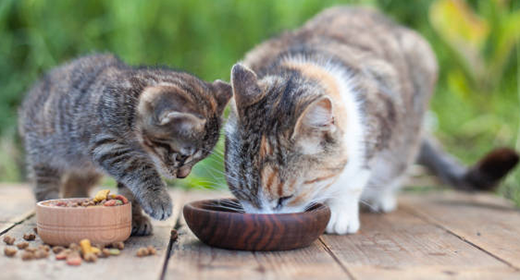
To ensure a nursing cat is getting enough nutrition, give her a nutrient-dense diet, such as kitten food. Without increasing the amount of food at each meal, increase the number of meals in the day. Free-choice feed her, offering unlimited access to dry food.
By 5 weeks, most kittens show an interest in their mother's food. Gradually, the kittens will begin eating solid food and nursing less. At the same time, the nursing cat will usually start eating less. Most kittens are completely weaned by eight weeks after birth. By this time, the mother's energy requirement is back to normal and she should be eating her usual pre-pregnancy diet.